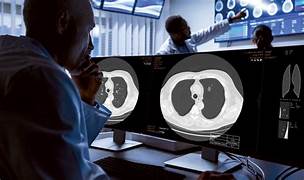
Conceptual representation of AI in Detection of Pneumonia.
Brief Overview
This project develops an AI system to automatically detect pneumonia from Chest X-ray images, specifically focusing on the needs and context of healthcare .
The primary goal is to enhance diagnostic accuracy, accelerate the detection process, and improve the accessibility of pneumonia diagnosis.
AI's Role
The core of this project utilizes Deep Learning, with a primary focus on Convolutional Neural Networks (CNNs)*.
Here's a detailed explanation of AI's role:
Automated Feature Learning: CNNs learn intricate visual features directly from vast datasets of labeled Chest X-ray images.
This eliminates the need for manual identification and programming of specific medical features. The network's layers progressively identify patterns indicative of pneumonia.
Pattern Recognition: Once trained, the AI model acts as a highly sophisticated pattern recognition system.
It can analyze new, unseen CXR images and identify subtle visual patterns that strongly suggest the presence of pneumonia.
Image Classification: The final stage involves the AI classifying the input CXR image by assigning a probability score.
This score represents the likelihood of pneumonia being present, providing a quantitative measure to support diagnosis.
Enhancing Diagnostic Capabilities:
Transfer Learning: The AI leverages pre-existing knowledge from models trained on massive general image datasets and adapts it to the specific task of pneumonia detection in CXRs.
This accelerates learning and improves performance, especially with potentially limited Indian medical image data.
Data Augmentation: AI techniques are employed to artificially increase the diversity of the training data.
This makes the model more robust and less prone to biases or overfitting to specific image characteristics prevalent in the training set.